やさしく学ぶ漢方の基本。前回の第4回では、体質タイプである「証(しょう)」についてお話ししました。 今回は、その体質をもっと詳しく見るためのものさし、「気・血・水(き・けつ・すい)」 について掘り下げていきます。
「検査では異常がないのに、なんだか調子が悪い…」 そんなとき、漢方ではこの3つのバランスが崩れていると考えることが多いんですよ。
1.体を支える3つの要素「気・血・水」って?
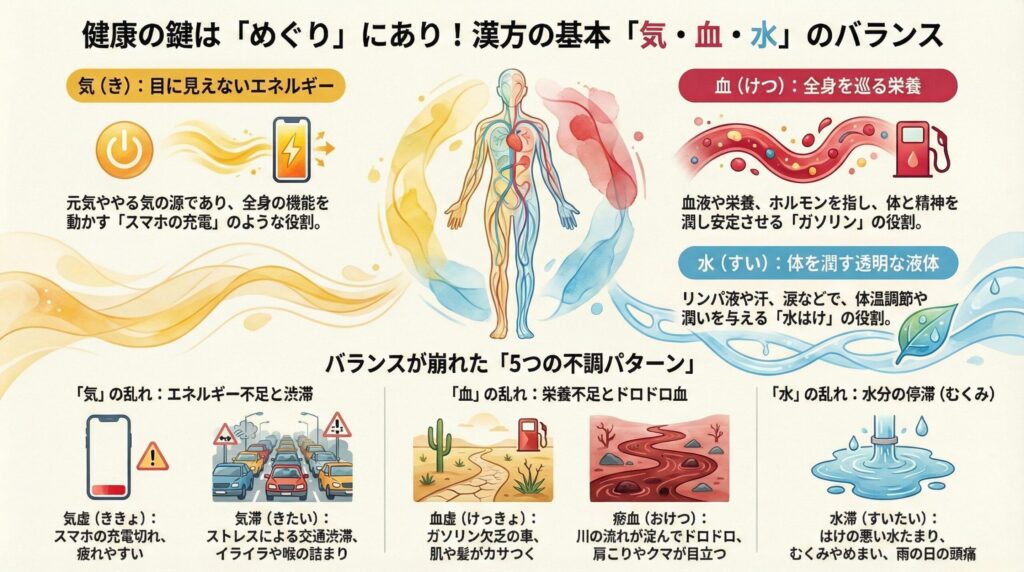
漢方では、人間の体は次の3つの要素で支えられていると考えます。
- ⚡️ 気(き): 目に見えないエネルギー。元気、やる気、神経の働きなど。
- 🩸 血(けつ): 血液と、それに運ばれる栄養・ホルモンなど。体を潤す赤い液体。
- 💧 水(すい): 血液以外の水分。リンパ液、汗、涙、尿など。体を冷やしたり潤したりする透明な液体。
この3つが**「足りているか?」そして「スムーズに流れているか?」**。 これが健康のバロメーターになります。
2.「気(き)」のトラブル ~エネルギー不足と渋滞~
「気」は、生命活動の根本となるエネルギーです。
① 気虚(ききょ):エネルギー不足 気が足りていない状態です。
- 症状: 疲れやすい、食欲がない、風邪をひきやすい、声が小さい。
- イメージ: 「スマホの充電切れ」。
- 対策: 胃腸をいたわり、しっかり睡眠をとる。漢方では「補中益気湯」などが有名です。
② 気滞(きたい):エネルギーの渋滞 気はあるけれど、めぐらずに詰まっている状態です。
- 症状: イライラ、喉のつまり感、お腹が張る、ゲップやおならが出る。
- イメージ: 「ストレスによる交通渋滞」。
- 対策: 香りの良いものを食べる、深呼吸、リラックス。漢方では「半夏厚朴湯」などが使われます。
3.「血(けつ)」のトラブル ~栄養不足とドロドロ~
「血」は、全身に栄養を運び、精神を安定させる働きもあります。
① 血虚(けっきょ):栄養・うるおい不足 血が足りていない状態です。
- 症状: 顔色が悪い、肌や髪がカサカサする、目が疲れる、不安感、眠りが浅い。
- イメージ: 「ガス欠の車」。
- 対策: 赤い食材(肉、魚、クコの実)や黒い食材(黒豆、ひじき)を摂る。漢方では「四物湯」などが代表的です。
② 瘀血(おけつ):血流の停滞 血の流れが悪く、滞っている状態です。漢方でとても重視される概念です。
- 症状: 肩こり、頭痛、シミ・くすみ、目の下のクマ、生理痛が重い。
- イメージ: 「川の流れが淀んでドロドロ」。
- 対策: 軽い運動で体を温める、冷やさない。漢方では「桂枝茯苓丸」などが有名です。
4.「水(すい)」のトラブル ~むくみとアンバランス~
「水」は、体を潤す大切なものですが、たまりすぎると悪さをします。
● 水滞(すいたい):水分の停滞 水のめぐりが悪く、余分な水がたまっている状態です(水毒とも言います)。
- 症状: むくみ、めまい、車酔いしやすい、雨の日に頭痛がする、体が重だるい。
- イメージ: 「水はけの悪い水たまり」。
- 対策: 水分を摂りすぎない、汗をかく運動をする、利尿作用のある食材(瓜類、豆類)を摂る。漢方では「五苓散」などが使われます。
5.3つは互いに助け合っている
「気・血・水」はバラバラに動いているわけではありません。
- 気が動くことで、血や水が流れる(気がポンプの役割)
- 血が充実していないと、気も落ち着かない
このように、お互いが影響し合っています。 だから漢方薬を選ぶときは、「気を補いながら、血もめぐらせる」といったように、複合的なアプローチをすることが多いのです。
6.まとめ
今回のまとめ
- 漢方では**「気(エネルギー)・血(栄養)・水(水分)」**のバランスを重視します。
- それぞれの要素には**「不足(足りない)」と「停滞(詰まっている)」**という不調パターンがあります。
- **「気虚」は充電切れ、「気滞」**はストレス渋滞。
- **「血虚」は栄養不足、「瘀血」**はドロドロ血流。
- **「水滞」**はむくみや雨の日の不調の原因になります。
自分の不調がどのタイプに当てはまるか、なんとなくイメージできましたか? 次回からは、こうした考え方を使って、もっと具体的な悩みへのアプローチを見ていきましょう!
Easy Guide to Learning Kampo: The Basics
In the previous Vol. 4, we talked about “Sho (Constitution Types).” This time, we will dig deeper into “Qi, Ketsu, and Sui (Energy, Blood, and Fluid),” which are the rulers used to examine that constitution in more detail.
“I don’t feel well, even though medical tests show nothing wrong…” In such cases, Kampo often considers that the balance of these three elements is disrupted.
1. What are the Three Elements Supporting the Body: “Qi, Ketsu, Sui”?
In Kampo, the human body is considered to be supported by the following three elements:
- ⚡️ Qi (Energy): Invisible energy. Vitality, motivation, nervous system function, etc.
- 🩸 Ketsu (Blood): Blood and the nutrients/hormones it carries. Red liquid that moisturizes the body.
- 💧 Sui (Fluid): Moisture other than blood. Lymph fluid, sweat, tears, urine, etc. Transparent liquid that cools and moisturizes the body.
Are these three “sufficient?” and are they “flowing smoothly?” This becomes the barometer of health.
2. Troubles with “Qi” (Energy) ~Deficiency and Congestion~
“Qi” is the fundamental energy of life activities.
① Qi Deficiency (Kikyo): Lack of Energy A state where Qi is insufficient.
- Symptoms: Easily tired, no appetite, catching colds easily, weak voice.
- Image: “A smartphone with a dead battery.”
- Countermeasures: Care for your stomach and intestines, get enough sleep. Kampo medicines like “Hochu-ekki-to” are famous.
② Qi Stagnation (Kitai): Energy Traffic Jam Qi is present but clogged and not circulating.
- Symptoms: Irritability, feeling of a lump in the throat, bloating, burping or gas.
- Image: “Traffic jam caused by stress.”
- Countermeasures: Eat fragrant foods, deep breaths, relax. Kampo medicines like “Hange-koboku-to” are often used.
3. Troubles with “Ketsu” (Blood) ~Lack of Nutrition and Sludge~
“Ketsu” carries nutrition throughout the body and also works to stabilize the mind.
① Blood Deficiency (Kekkyo): Lack of Nutrition & Moisture A state where blood is insufficient.
- Symptoms: Pale complexion, dry skin or hair, tired eyes, anxiety, light sleep.
- Image: “A car running out of gas.”
- Countermeasures: Eat red ingredients (meat, fish, goji berries) or black ingredients (black beans, hijiki seaweed). Kampo medicines like “Shimotsu-to” are representative.
② Blood Stasis (Oketsu): Stagnation of Blood Flow A state where blood flow is poor and stagnant. This is a very important concept in Kampo.
- Symptoms: Stiff shoulders, headaches, spots/dullness, dark circles under eyes, heavy menstrual pain.
- Image: “A river flow becoming stagnant and muddy.”
- Countermeasures: Light exercise to warm the body, avoid cooling down. Kampo medicines like “Keishi-bukuryo-gan” are famous.
4. Troubles with “Sui” (Fluid) ~Swelling and Imbalance~
“Sui” is important for moisturizing the body, but too much accumulation causes trouble.
● Fluid Stagnation (Suitai): Stagnation of Water A state where water circulation is poor and excess water accumulates (also called Water Toxin).
- Symptoms: Edema (swelling), dizziness, motion sickness, headaches on rainy days, heavy feeling in the body.
- Image: “A puddle with poor drainage.”
- Countermeasures: Do not consume too much water, exercise to sweat, eat ingredients with diuretic effects (melons, beans). Kampo medicines like “Goreisan” are used.
5. The Three Help Each Other
“Qi, Ketsu, and Sui” do not move separately.
- When Qi moves, Ketsu and Sui flow (Qi acts as a pump).
- If Ketsu is not sufficient, Qi will not settle down.
In this way, they influence each other. Therefore, when choosing Kampo medicine, a composite approach is often taken, such as “circulating blood while supplementing Qi.”
6. Summary
Summary of this session:
- Kampo emphasizes the balance of “Qi (Energy), Ketsu (Nutrition/Blood), and Sui (Moisture).”
- Each element has trouble patterns of “Deficiency (Not enough)” and “Stagnation (Clogged).”
- “Qi Deficiency” is a dead battery, “Qi Stagnation” is a stress traffic jam.
- “Blood Deficiency” is a lack of nutrition, “Blood Stasis” is muddy blood flow.
- “Fluid Stagnation” causes swelling and discomfort on rainy days.
Could you imagine which type your discomfort falls into? From the next time, let’s use these concepts to look at approaches for more specific worries!