やさしく学ぶ漢方の基本
「同じ風邪なのに、どうして飲む漢方薬が人によってちがうの?」
「人に勧められた漢方が、自分にはいまいち効かなかった…」
そんな“ふしぎ”のカギになるのが、今回のテーマ 「証(しょう)」=体質タイプの考え方 です。
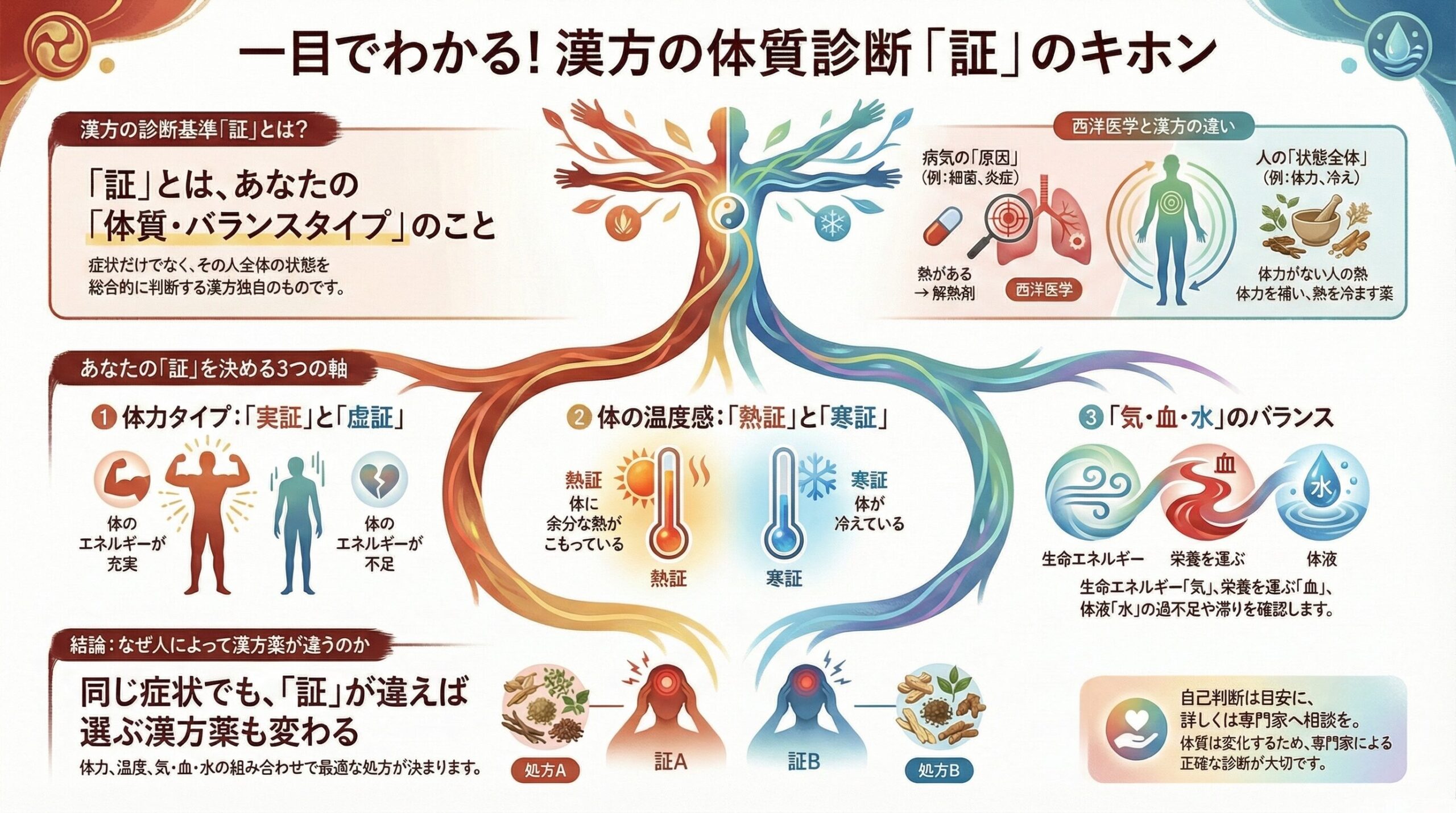
1.漢方でとっても大事な「証(しょう)」ってなに?
西洋医学では、
- 熱がある → 解熱剤
- 細菌がいる → 抗生物質
…というように、「原因」や「検査の数値」に合わせてお薬を決めることが多いです。
一方、漢方ではそれにくわえて、
- その人の体力は強い?弱い?
- 冷えやすい?のぼせやすい?
- むくみやすい?カサカサしやすい?
といった 「その人全体の状態」 をとても大切にします。
この「その人全体の状態」をまとめて表したのが、漢方でいう 「証(しょう)」 です。
やさしく言いかえると、
「いまのあなたの体質タイプ・バランスタイプ」
みたいなイメージです。
2.まずはざっくり!3つの体力タイプ
漢方では、体の「強さ」「元気さ」も見ていきます。
ここではわかりやすく、3タイプに分けてみましょう。
① 実証(じっしょう)タイプ
- 体力がある
- 顔色はどちらかというと赤みがち
- 食欲もまあまあある
- イライラしやすい、肩がガチガチになることも
→ しっかりしたパワーがあるぶん、熱がこもったり、詰まったりしやすいタイプ。
余分なものを「さばく」「さます」漢方を使うことが多いです。
② 虚証(きょしょう)タイプ
- 体力に自信がない、疲れやすい
- 顔色が少し青白いことがある
- 冷えやすい、風邪をひきやすい
- 長くグズグズと不調が続きがち
→ からだのエネルギーが少なめで、“足りない・弱っている”イメージ。
元気を「補う」「あたためる」漢方を使うことが多いです。
③ その中間タイプ
- すごく元気!でもない
- すごく弱い…ほどでもない
→ 実証と虚証のあいだくらいで、状況によってどちら寄りかを見ていきます。
3.冷え?のぼせ?「寒証」と「熱証」
つぎは、体の“温度感”です。
● 寒証(かんしょう)タイプ
- 手足が冷えやすい
- 冬がとても苦手
- 温かい飲みもの・料理が好き
- お腹や腰が冷えて痛くなることも
→ からだの中が冷えていたり、温める力が弱いタイプ。
温める漢方(しょうが・シナモン・附子などを含む処方)が選ばれやすいです。
● 熱証(ねっしょう)タイプ
- 顔が赤くなりやすい
- のぼせやすい・ほてりやすい
- 口がかわきやすく、冷たい飲みものが好き
- イライラ・怒りっぽさが出やすい
→ からだの中に“余分な熱”をため込みやすいタイプ。
熱をさましたり、余分なものを外に出したりする漢方がよく使われます。
4.「気・血・水(き・けつ・すい)」ってなあに?
漢方では、体の中をめぐっている大事なものとして、
- 気(き) … エネルギー・元気のようなもの
- 血(けつ) … 血液だけでなく、うるおい・栄養をふくんだ流れ
- 水(すい) … 血以外の水分(リンパ・体液・むくみなどのイメージ)
という3つをよく使います。
この 気・血・水のどこが足りない?どこが滞っている? を見ることで、
同じ「頭痛」でも、選ぶ漢方が変わってきます。
たとえば…
- 気が足りない → 疲れやすい、やる気が出ない、声が小さい
- 血のめぐりが悪い → 肩こり、頭痛、冷え、シミ・くすみ
- 水がたまる → むくみ、重だるさ、めまい、雨の日に調子が悪い
「症状」だけでなく、「その人の全体のバランス」を見ていくのが、漢方の大きな特徴です。
5.だから、人によって漢方薬がちがうんです
ここまでのポイントをまとめると…
- 体力(実証・虚証)
- 温度感(寒証・熱証)
- 気・血・水のバランス
こういった 体質タイプ(証) を組み合わせて、
「今のあなた」に合う漢方薬を選んでいく、という考え方なんですね。
6.セルフチェックは“目安”に、詳しくはご相談を
インターネット上には、体質チェックリストがたくさんあります。
自分のタイプを知る“きっかけ”としては、とても良いと思います。
でも実際には、
- 年齢や季節でも体質はゆらぐ
- いくつかのタイプがまじっていることも多い
- いま飲んでいるお薬や持病によって、使えない漢方もある
などなど、プロでないと判断がむずかしい部分もたくさんあります。
7.まとめ
今回のまとめ
- 漢方では「証(しょう)」=体質タイプをとても大切にします
- 体力(実証・虚証)、寒証・熱証、気・血・水のバランスを見ていきます
- 同じ「咳」「頭痛」でも、体質がちがえば選ぶ漢方も変わります
- 自己判断しすぎず、気になるときはぜひ専門家に相談を
Gently Learning the Basics of Kampo
Lesson 4: Find Your Body Type – What Is “Sho” in Kampo?
“Why do people with the same cold take different Kampo medicines?”
“My friend’s Kampo medicine worked for her, but it didn’t really work for me…”
The key to these little mysteries is today’s theme:
“Sho” (証) – how Kampo looks at your body type and current condition.
1. What Is “Sho” in Kampo?
In Western medicine, doctors often choose medicines based on:
- You have a fever → take an antipyretic (fever reducer)
- You have a bacterial infection → take an antibiotic
In other words, the focus is usually on the cause and test results.
In Kampo, we also look at those things, but in addition we carefully observe:
- Is your overall physical strength strong or weak?
- Do you tend to feel cold? Or do you tend to feel hot or flushed?
- Do you get swelling easily? Or are you more dry and rough?
This kind of “whole-person condition” is very important in Kampo.
This whole condition is summarized as “Sho” (証).
To say it more simply:
“Your current body type / balance type”
That is what Sho means in Kampo.
2. First Step: Three Basic Levels of Physical Strength
Kampo also pays attention to your overall physical strength.
Here, let’s divide it into three easy types.
① Jissho (実証) – “Full” or “Strong” Type
- Generally strong and energetic
- Face may be slightly reddish
- Normal or strong appetite
- May get stiff shoulders, or feel irritable easily
→ Because there is plenty of power, this type can easily build up excess “heat” or tension.
Kampo formulas that “clear heat,” “release stagnation,” or “disperse” excess are often used.
② Kyosho (虚証) – “Deficient” or “Weak” Type
- Easily tired, not much stamina
- Face may look a bit pale
- Often feels cold, easily catches colds
- Tends to have long‑lasting, lingering complaints
→ The body’s energy is relatively low – “lacking” or “weakened.”
Kampo formulas that “tonify,” “nourish,” and “warm” are often chosen.
③ In-Between Type
- Not extremely strong
- Not extremely weak
→ Somewhere between Jissho and Kyosho, and we look at which side you lean toward depending on your current state.
3. Cold? Or Hot? “Kansho” and “Nessho”
Next, let’s look at your internal “temperature feeling.”
● Kansho (寒証) – Cold Type
- Hands and feet feel cold easily
- Really dislikes cold weather
- Prefers warm drinks and hot meals
- May have stomach or lower back pain that gets worse with cold
→ The inside of the body is cold, or the warming power is weak.
Kampo formulas that warm the body (for example, those including ginger, cinnamon, processed aconite, etc.) are often used.
● Nessho (熱証) – Hot Type
- Face tends to flush or turn red
- Easily feels hot or has hot flashes
- Often thirsty, likes cold drinks
- May feel irritated or short-tempered
→ This type tends to accumulate excess heat inside the body.
Kampo formulas that cool heat or help discharge what is excessive are often chosen.
4. What Are “Qi, Blood, and Fluid”?
In Kampo, we often talk about three important things that circulate in the body:
- Qi (気) – life energy, vitality, “drive”
- Blood (血) – not only blood itself, but also the nourishing flow that brings color and moisture
- Fluid (水) – body fluids other than blood (like lymph, internal fluids, the “water” that can cause swelling)
We look at which of these is lacking, and where things are stuck or not flowing well.
That is why, even for the same symptom like “headache,” the Kampo prescription can be different.
For example…
- When Qi is deficient → you tire easily, lack motivation, have a weak voice
- When Blood flow is poor → stiff shoulders, headaches, cold extremities, dull complexion or spots
- When Fluids accumulate → swelling, heavy sluggish feeling, dizziness, feeling worse on rainy or humid days
Instead of focusing only on “the symptom,” Kampo puts great emphasis on your overall balance as a person.
5. Why Different People Take Different Kampo Medicines
To sum up what we’ve seen:
- Your physical strength (Jissho vs. Kyosho)
- Your internal temperature feeling (Kansho vs. Nessho)
- The balance of Qi, Blood, and Fluid
By combining these elements, Kampo practitioners decide which formula fits “you right now.”
That is why:
“Even if two people both have a cough or a headache,
their Kampo prescriptions can be completely different.”
6. Use Self-Checks as a Hint – But Please Get Proper Advice
There are many “body-type check” quizzes and tests online.
They can be very helpful as a first step to get to know yourself.
However, in real life:
- Your body type can change with age and seasons
- It’s common to have a mix of several types
- Depending on your current medicines or chronic diseases, some Kampo formulas are not suitable
Because of these reasons, there are many parts that are difficult to judge on your own.
7. Summary
Today’s main points
- In Kampo, “Sho” (証) – your current body type and condition – is extremely important
- We look at physical strength (Jissho/Kyosho), cold vs. heat (Kansho/Nessho), and the balance of Qi, Blood, and Fluid
- Even if the symptom name is the same, the Kampo medicine can be different depending on your Sho
- Please don’t rely only on self-judgment – consult a professional when in doubt
At our pharmacy, we are always happy to discuss:
- “I want to know which Kampo medicine fits me.”
- “I’m not sure if I’m taking my Kampo the right way.”
Please feel free to consult us anytime.